Published on:12-10-2026
Last updated:12-10-2026
Understanding HDL vs LDL is the quickest way to make sense of a cholesterol report. HDL carries extra cholesterol away from your arteries. LDL can leave it behind in artery walls when levels run high. Triglycerides are a separate blood fat that adds to the risk. Here's what each number means, the ranges doctors use and the steps that actually move them.
Table of Contents
- What Is Good Cholesterol and Bad Cholesterol?
- HDL vs LDL Cholesterol Difference
- Where Do Triglycerides Fit In?
- What Your Cholesterol Test (Lipid Panel) Shows
- Healthy Cholesterol Levels by Age
- High Cholesterol Risks and What Causes Them
- How to Lower LDL Cholesterol and Raise HDL Naturally
- When Is Medication Necessary?
- Conclusion
- Frequently Asked Questions
What Is Good Cholesterol and Bad Cholesterol?
Cholesterol is a waxy fat your body needs to build cells, make hormones and produce vitamin D. Your liver makes most of it on its own.
Cholesterol can't move through blood by itself. It travels inside protein-coated particles called lipoproteins. Two of them matter most:
- Low density lipoprotein (LDL), often called bad cholesterol
- High density lipoprotein (HDL), often called good cholesterol
The cholesterol inside both is identical. The labels describe where each particle takes it.
HDL vs LDL Cholesterol Difference
The HDL vs LDL cholesterol difference comes down to direction. One delivers cholesterol out into the body. The other carries it back.
LDL (The Harmful Cholesterol)
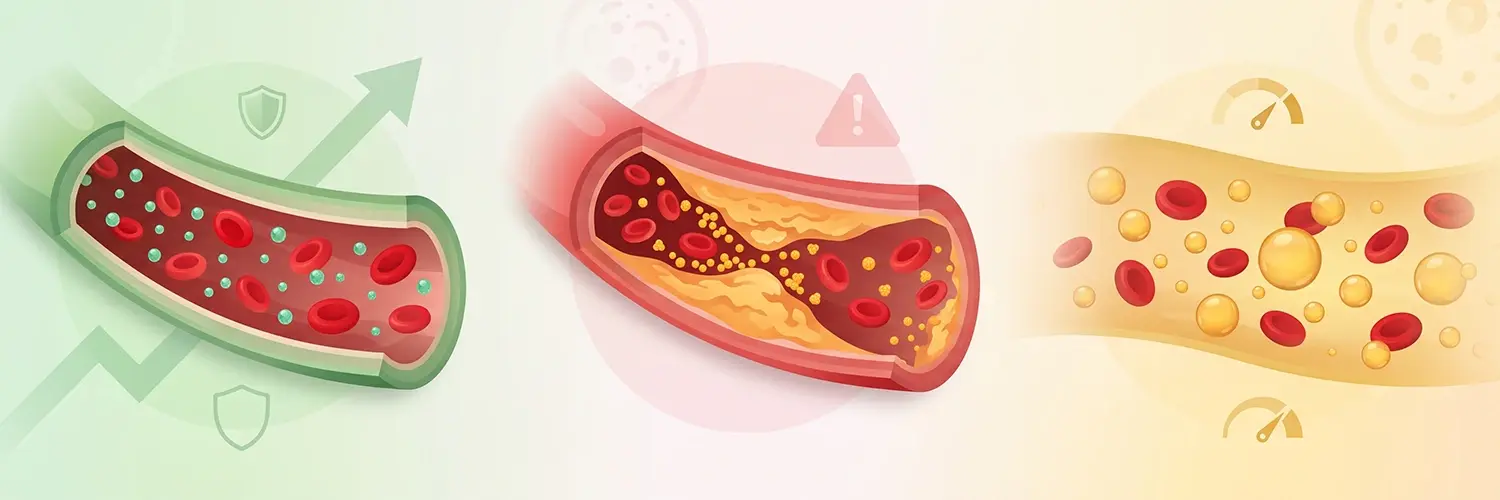
LDL carries cholesterol from the liver to tissues that need it. When there's more LDL than the body can use, particles slip into artery walls and stay there.
Over the years, this causes atherosclerosis, a plaque buildup that slowly narrows the artery. If a plaque cracks, a clot can form on top of it. That is how most heart attacks and many strokes begin.
HDL (The Protective Cholesterol)
HDL picks up extra cholesterol from tissues and artery walls and returns it to the liver for disposal. That's why higher HDL is generally linked with lower heart risk.
More isn't always better, though. A 2017 Copenhagen study of over 116,000 adults found higher death rates in people with extremely high HDL. Drugs designed only to raise HDL also failed to prevent heart attacks in clinical trials. Lowering LDL remains the main goal of treatment.
Where Do Triglycerides Fit In?
Triglycerides aren't cholesterol. They're the most common fat in your body. Calories you don't burn right away, especially from sugar, white bread and alcohol, get stored as triglycerides.
Trouble starts when levels stay high. Doctors often spot a pattern called the lipid triad:
- High triglycerides
- Low HDL
- Many small, dense LDL particles that enter artery walls easily
This pattern is closely tied to insulin resistance. It shows up often with prediabetes, type 2 diabetes and extra belly fat. Very high triglycerides, 500 mg/dL or more, also raise the risk of pancreatitis.
What Your Cholesterol Test (Lipid Panel) Shows
A cholesterol test, also called a lipid panel, is a quick blood draw. It reports total cholesterol, LDL, HDL and triglycerides. Many reports also list non-HDL cholesterol, which is total cholesterol minus HDL. It counts every particle that can build plaque.
Most people no longer need to fast first. Your doctor may still ask for a 9 to 12 hour fast if your triglycerides were high before.
How often to get tested, based on NIH guidance:
- Children: Once between ages 9 and 11 and again between 17 and 21
- Healthy adults: Every 5 years starting at age 20
- Men 45 to 65 and women 55 to 65: Every 1 to 2 years
- Adults over 65: Once a year
- Anyone with high numbers, diabetes or heart disease: As often as your doctor advises
Healthy Cholesterol Levels by Age
Healthy cholesterol levels by age differ mainly between children and adults. These ranges come from the National Heart, Lung and Blood Institute. All values are in mg/dL.
| Measurement | Age 19 and Younger | Men 20+ | Women 20+ |
|---|---|---|---|
| Total Cholesterol | Below 170 | 125 to 200 | 125 to 200 |
| LDL | Below 110 | Below 100 | Below 100 |
| HDL | Above 45 | 40 or higher | 50 or higher |
| Non-HDL | Below 120 | Below 130 | Below 130 |
| Triglycerides | Below 90 (below 75 under age 10) | Below 150 | Below 150 |
Numbers tend to rise with age. Women often see LDL climb after menopause, so a normal result at 40 doesn't guarantee one at 55.
Your personal target may also be lower. With diabetes, past heart disease or several cardiovascular risk factors, your doctor may aim for an LDL below 70.
Adult LDL and Triglyceride Categories
The triglycerides normal range for adults is below 150 mg/dL. Here's how both numbers are graded:
| Category | LDL (mg/dL) | Triglycerides (mg/dL) |
|---|---|---|
| Optimal / Normal | Below 100 | Below 150 |
| Near Optimal | 100 to 129 | Not used |
| Borderline High | 130 to 159 | 150 to 199 |
| High | 160 to 189 | 200 to 499 |
| Very High | 190 or higher | 500 or higher |
Read these numbers together. An LDL of 125 with an HDL of 70 carries less risk than the same LDL with an HDL of 35.
High Cholesterol Risks and What Causes Them
High cholesterol risks are easy to overlook because there are usually no symptoms. Most people find out from a blood test. Over time, high LDL raises the chance of coronary artery disease, heart attack, stroke and peripheral artery disease.
Common causes include:
- Diet: Saturated fats in red meat, butter and full-fat dairy raise LDL. Trans fats in some fried and packaged foods do the same.
- Inactivity: Sitting most of the day lowers HDL and raises triglycerides.
- Extra weight: Fat around the waist is closely linked to the lipid triad.
- Smoking: It lowers HDL and damages artery linings.
- Genetics: Familial hypercholesterolemia affects about 1 in 250 people and can push LDL above 190 from childhood, even with a healthy diet.
- Other conditions: Type 2 diabetes, hypothyroidism, kidney disease and some medicines can raise lipid levels.
How to Lower LDL Cholesterol and Raise HDL Naturally
For many people, lifestyle changes alone can bring cholesterol into a healthier range. For others, these changes help medication work better.
Dietary Changes That Work
Swap saturated fats for unsaturated ones. Cook with olive or canola oil instead of butter, snack on nuts instead of chips and choose fatty fish over red meat. The American Heart Association suggests keeping saturated fat under 6% of daily calories.
Add soluble fiber from oats, beans, lentils, apples and citrus. Cutting added sugar matters too, since sugar drives triglycerides up even when fat intake is low.
Exercise
Aim for 150 minutes of moderate aerobic activity a week. Brisk walking, cycling and swimming all count. Regular movement is one of the most reliable ways to raise HDL and lower triglycerides and it doesn't need to be intense. Pairing exercise with other simple lifestyle adjustments amplifies the effect on overall metabolic health.
Other Steps That Help
- Quit smoking. HDL tends to rise within months of stopping.
- Lose extra weight. Dropping 5% to 10% of body weight can lower triglycerides and lift HDL.
- Limit alcohol. Even moderate drinking can push triglycerides up.
- Protect your sleep and manage stress. Both affect weight, blood sugar and eating habits, which shape your lipid numbers.
When Is Medication Necessary?
Lifestyle changes come first, but they aren't always enough. Your doctor may recommend medication if:
- Your LDL stays high despite steady diet and exercise changes
- Your LDL is 190 or higher or you have familial hypercholesterolemia
- You already have heart disease or have had a stroke
- You have diabetes or several cardiovascular risk factors, such as high blood pressure or a smoking history
Statin medication is the usual first choice for lowering cholesterol. Depending on the dose, statins reduce LDL by 30% to 50% or more. Other options include ezetimibe, PCSK9 inhibitors and for high triglycerides, fibrates or prescription omega-3s.
At Springfield Medical Clinic, the decision to start medication is never based on one lab result. We review your lipid panel alongside blood pressure, blood sugar and family history first. Healthy habits still matter once treatment begins.
Conclusion
HDL, LDL and triglycerides each play a different role in heart health. High LDL builds plaque in your arteries. Low HDL means less extra cholesterol gets cleared. High triglycerides add to the damage. All three respond to diet, exercise and weight loss. When lifestyle isn't enough, medication can help and knowing how to lower LDL cholesterol early gives you more options.
If your last lipid panel was over a year ago, or you've never had one, schedule an appointment at Springfield Medical Clinic. The blood draw takes minutes and the results show exactly where your heart risk stands.
Frequently Asked Questions
- Is HDL or LDL more important?
LDL is the most actionable number because it directly contributes to plaque buildup. The ratio of total cholesterol to HDL gives a more complete risk picture. - Can you have high cholesterol and still be healthy?
Yes, if the elevation is driven by high HDL (the protective type). The real concern is high LDL combined with low HDL. - How quickly can cholesterol improve with diet and exercise?
Most patients see changes within 6 to 12 weeks. Triglycerides respond fastest, often dropping within 2 to 4 weeks of cutting added sugars. - Do eggs raise cholesterol?
For most people, eggs have a modest effect compared to saturated and trans fats. Patients with cardiovascular disease should discuss egg intake with their doctor. - How often should cholesterol be tested?
Every 4 to 6 years for healthy adults. Annually for anyone with elevated numbers, heart disease history or who is on cholesterol-lowering medication.